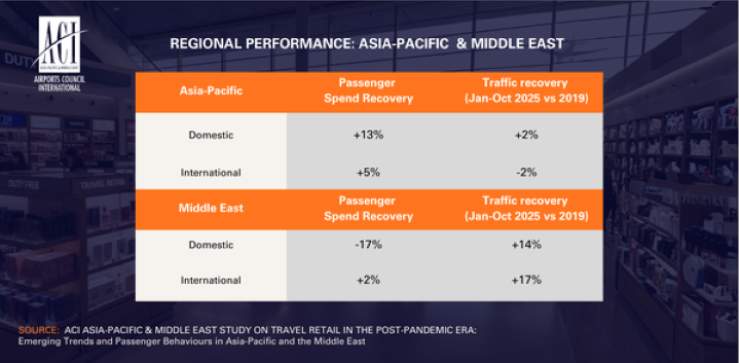

Developed by ACI APAC & MID, in partnership with Auran and Steer, the study spans 36 major airports in 21 countries and draws on insights from retailers and passengers. It finds that despite traffic surpassing 2019 levels, travel retail growth now hinges on passenger mix, behaviour, and preferences, not traffic volumes alone.
• 56 percent of responding airports say their commercial revenue is now stronger than 2019 levels.
• 44 percent of airports expect higher commercial revenue per passenger in the next 12 months.
• Airports cite perfume and cosmetics as the strongest-performing category post-2019.
• Passenger demographics and price competitiveness are key drivers of retail performance.
Younger travellers, particularly Gen Z and Millennials, have overtaken older generations as the primary spenders at airport when indexed against Boomers:
• Gen Zs and Millennials spend 3.5 times higher than Gen X and Boomers
• Gen Zs are four times more likely than Boomers to buy electronics
• Gen Zs are 2.5 times more likely than Boomers to buy luxury products
• Boomers are 1.4 times more likely than Gen Z to buy confectionary products
*Boomers: 1946-1964 | Gen X: 1965-1980 | Millennials: 1981-1996 | Gen Z: 1997-2012
Unlike older generations, who remain more price-sensitive and category-conservative, Millennials and Gen Z are the primary drivers of spending on luxury goods and perfumes and cosmetics. They also demonstrate a strong preference for local, culturally relevant products, shifting demand toward destination-linked purchases supported by storytelling and authenticity.
Stefano Baronci, director general, ACI Asia-Pacific & Middle East said, “The traditional assumption that commercial performance scales automatically with passenger volumes is no longer reliable. What this study highlights is a structural change: as passenger behaviour becomes more segmented, revenue outcomes depend increasingly on who travels, not simply how many travel. This shift matters because airports operate with high fixed costs and long investment horizons. When financial growth is not volume driven, optimising the commercial performance becomes a matter of financial resilience. In that context, non-aeronautical revenues, and travel retail and duty free play a significant role in airport business models. Airports that align their commercial strategies with evolving passenger behaviour are better equipped to manage revenue volatility, sustain investment capacity, and remain competitive over the long term.”